

If you are selling final expense insurance, you already know it's a numbers game. But what most agents don't realize is that where you play the game matters just as much as how hard you work.
Many agents default to selling only in their home state, or they blindly buy non-resident licenses in massive states like California or New York just because they have huge populations. In the final expense world, that is a fast track to high lead costs, brutal competition, and high lapse rates.
To build a highly profitable book of business, you need geographic arbitrage — finding the sweet spot where marketing costs are low, the target senior demographic is dense, and state licensing rules don't slow you down.
General insurance jobs are highly concentrated in specific economic hubs. However, for final expense professionals, the real goldmines are dictated by senior logistics, not just corporate job listings.
Whether you are a field agent mapping out a local route or a telesales pro building a multi-state dialing ring, this guide breaks down the absolute best states to target this year. (New to live transfers? See how our live transfer process works before you scale.)
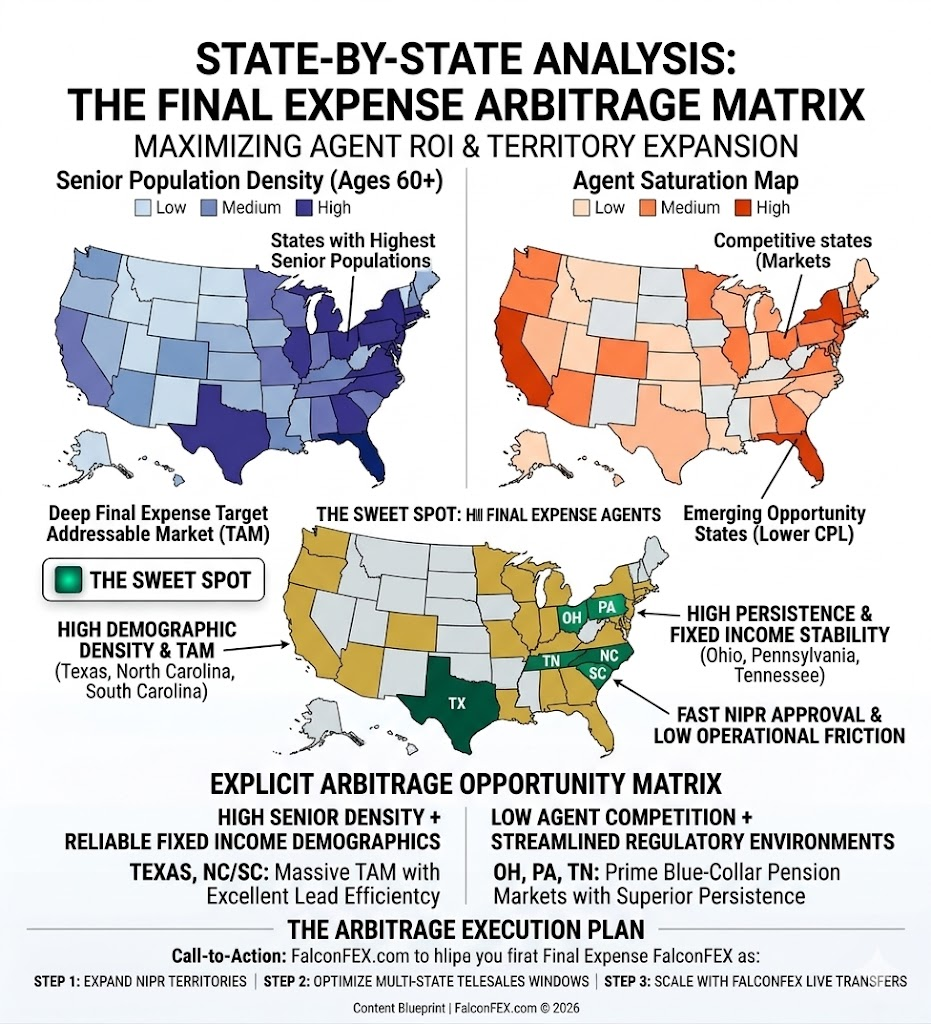
The FalconFEX Formula: What Makes a State "Good" for Final Expense?
Before we look at the specific states, let's talk about the metrics that actually matter for a final expense agent. We look at four core pillars:
Target Demographic Density
High concentrations of seniors 60-80 with household incomes $20K-$55K — the prime burial protection buyer.
Economic Reliability
Stable Social Security and blue-collar pension income keeps policies in force and renewals safe.
Operational Ease & NIPR Speed
Some states approve non-resident licenses in 48 hours via NIPR. Others bog you down with fingerprints and fees.
Lead Cost & Competition
We hunt states where direct mail still wins and digital/live-transfer leads remain cost-effective.
Top-Tier States: The Gold Standard
These states offer the absolute best mix of target demographics, high response rates, and friendly licensing environments.
1. Texas
The Opportunity: Texas is a massive powerhouse for final expense. It features an incredibly diverse, rapidly aging population with massive clusters of blue-collar, retired communities in both semi-urban and rural areas.
Why It Wins: Response rates to final expense marketing are consistently high across the state. Because of its vast geography, it is a goldmine for both local field agents working tertiary towns and telesales teams dialing high volumes.
Licensing Ease: Texas is highly reciprocal and processes non-resident applications through NIPR incredibly fast.
2. Ohio & Pennsylvania (The Rust Belt Strongholds)
The Opportunity: These states are packed with traditional, working-class manufacturing and union retirees.
Why They Win: The senior populations here rely heavily on stable, predictable pensions and Social Security. They have a very high cultural awareness of the burden of end-of-life costs, making them highly receptive to burial insurance. Policies written in the Rust Belt traditionally boast excellent persistence and low lapse rates.
Lead Advantage: Seniors in these regions still respond exceptionally well to traditional direct mail and localized incoming phone leads.
3. North Carolina & South Carolina
The Opportunity: The Carolinas feature a massive concentration of family-oriented, faith-based senior communities that fit the exact final expense buyer profile.
Why They Win: Because family and community structure are central in these regions, final expense coverage is viewed as a highly necessary, unselfish purchase.
Lead Advantage: Marketing competition is more moderate here compared to major metropolitan centers, which keeps localized digital lead and live-transfer acquisition costs down.
4. Florida (With a Telesales Catch)
The Opportunity: Florida has the highest density of seniors over the age of 65 in the country.
Why It Wins: If you are a face-to-face field agent, Florida is unmatched. You can easily map out high-density senior communities and mobile home parks, maximizing your daily drive time.
The Catch: Because every agent knows Florida is a senior hotspot, the local lead market is highly saturated. Generic direct mail and digital leads are more expensive here. If you are doing telesales, you need highly targeted lists or specific inbound routing to win in Florida.
Key Takeaway: The "best" state isn't the biggest — it's the one where your CPL, persistence, and licensing speed line up. Texas, the Carolinas, and the Rust Belt consistently outperform on all three.
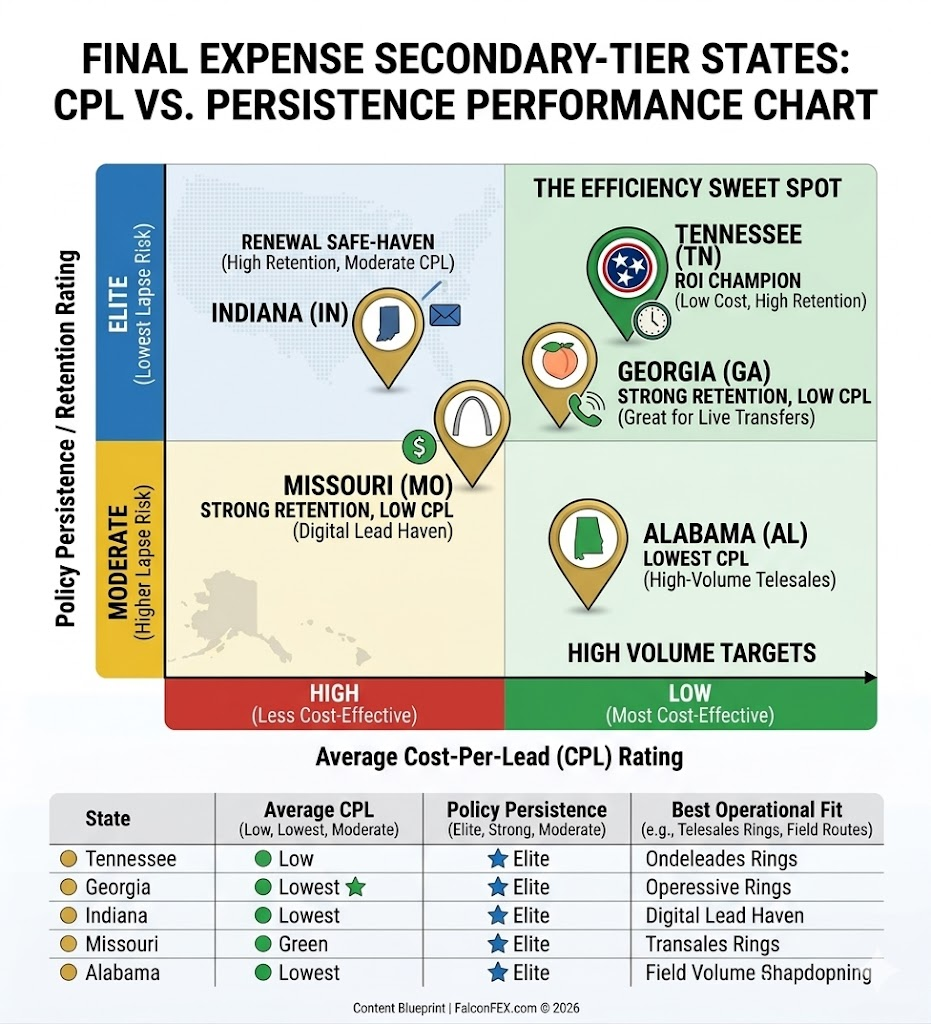
Secondary Powerhouses: High-Yield States to Add Next
If you already have your primary licenses and want to expand your footprint to diversify your lead costs, add these states to your portfolio next:
Georgia & Alabama
Deeply rooted markets for low-to-middle-income fixed-income seniors. Less expensive local media keeps inbound digital leads and live-call transfers cost-effective.
Tennessee
High inbound migration of retirees, zero state income tax on wage revenue, and a senior base that responds beautifully to final expense messaging.
Indiana & Missouri
Stable, blue-collar economies with straightforward insurance departments that issue non-resident licenses with very little friction.
Proceed With Caution: High-Friction States
While broad market job boards frequently list major financial hubs as top destinations for general corporate insurance agents, these locations are often financial traps for independent final expense agents:
Watchlist: California & New York
- •Regulatory Red Tape: Steep licensing fees and strict compliance rules, especially around replacement policies. See our TCPA & final expense compliance framework for what we vet on every transfer.
- •Economic Pressure: High cost of living squeezes fixed-income seniors. Policies often get cancelled first, hurting chargeback rates.
- •Signature Issues: Strict rules around voice vs. wet signatures can disrupt a smooth telesales workflow.
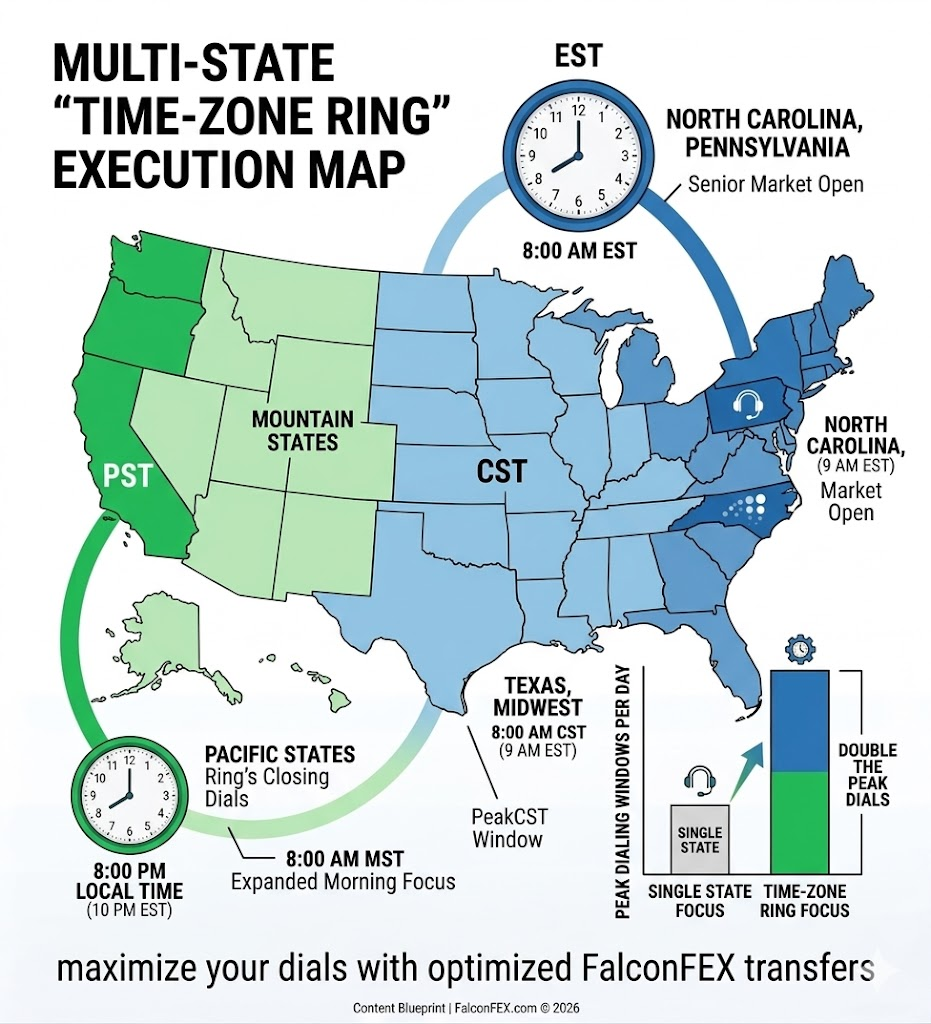
Strategy: Building Your Multi-State "Dialing Ring"
If you are a telesales agent, the secret to massive volume is building a time-zone ring.
By holding licenses across multiple time zones, you can easily open your day calling seniors on the East Coast (e.g., North Carolina, Pennsylvania) at 8:00 AM EST, move into the Midwest and Texas by midday, and finish your evening dialing Mountain or Pacific states up until 8:00 PM local time. This layout doubles your peak dialing windows every single day.
Timing matters as much as geography — not every hour converts the same. Our Telesales Golden Hours guide breaks down final expense conversion by time zone and hour, so you know exactly when each ring of your dialing ring is worth switching on.
Your Next Operational Steps
- 1
Audit Your Portfolio
Check your current state licenses against the high-performing fixed-income states above.
- 2
Hop on NIPR
Apply for non-resident licenses in fast-approving, high-yield states like Texas, Ohio, or North Carolina to instantly expand your footprint.
- 3
Secure Premium Lead Flow
Once your multi-state footprint is active, stop wasting hours chasing old, cold internet leads. Listen to real FalconFEX live transfer recordings to hear the quality before you commit.
Sources & References
Cited Data & Research
- 1
U.S. Census Bureau — Older Population Trends
Used to track senior demographic densities and target addressable age cohorts nationwide.
census.gov/topics/population/older-aging.html - 2
National Insurance Producer Registry (NIPR)
Used to verify cross-state non-resident licensing reciprocity rules, lines of authority, and processing timelines.
nipr.com - 3
Administration for Community Living (ACL) — Profile of Older Americans
Used to pull exact socioeconomic benchmarks, median senior income constraints, and fixed-income pension concentrations.
acl.gov — Profile of Older Americans 2023 (PDF) - 4
Visual Capitalist / Kaiser Family Foundation (KFF) — U.S. States by Share of Older Adults
Used to calculate geographic arbitrage scores, cross-referencing localized 65+ density against state-by-state migration.
visualcapitalist.com — Map: U.S. States by Share of Older Adults - 5
Zippia — Insurance Industry Employment Data
Used to contrast broad market corporate insurance job indices against targeted direct-to-consumer final expense lead availability.
zippia.com
Keep Reading
The 10 Best Final Expense Live Call Transfer Companies for 2026
Vetted, consultant-grade ranking of the top providers.
The Rising Need for Final Expense Insurance
Demographics, real funeral costs, and what every producer should know.
Telesales Golden Hours: Call Transfer Conversion by Time Zone & Hour
When your multi-state ring actually converts — hour-by-hour benchmarks.
