
The Rising Need for Final Expense Insurance: Safeguarding Your Family in Changing Times

Planning for the future is something we do throughout our lives — we save for retirement, invest in our homes, and build nest eggs for our children. Yet, one of the most inevitable certainties of life is often the one we are least prepared to fund: our final expenses.
For decades, end-of-life coverage was viewed as an optional, niche segment of the financial services industry. However, a perfect storm of shifting demographics, relentless inflation, and evolving family dynamics has transformed final expense insurance from a specialized product into an essential pillar of modern household financial planning.
When a loved one passes away, the emotional weight is heavy enough. Dealing with a sudden, multi-thousand-dollar financial crisis at the same time is a traumatic burden that no family should have to carry. To understand why final expense coverage has seen such dramatic growth, we must take a hard, transparent look at the economic reality of modern end-of-life expenses in America.
1. The "Silver Tsunami": An Aging Nation Proactively Planning
The primary driver behind the skyrocketing demand for final expense insurance is basic biology and demographics. The United States is experiencing an unprecedented demographic shift, often referred to by economists and sociologists as the "Silver Tsunami."
According to recent data from the U.S. Census Bureau (2026), the country's median age continues its steady upward climb, sitting at an all-time high of nearly 40 years old. Large bubbles in our demographic structure — specifically the massive generation of Baby Boomers born between 1946 and 1964 — are now moving rapidly into their late 60s, 70s, and 80s.
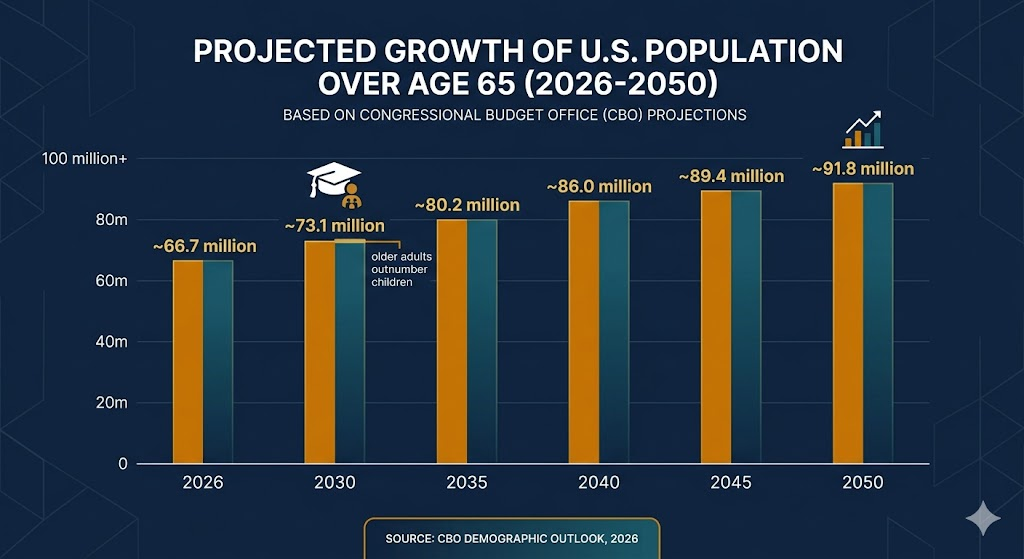
Projections from the Congressional Budget Office (CBO, 2026) indicate that the segment of the population aged 65 or older will grow faster than any other age bracket over the coming decades. Demographic modeling shows that older adults will officially outnumber children under the age of 18 for the first time in American history.
What does this mean for everyday families? Millions of households are concurrently entering a season of life where they must navigate end-of-life planning. Fortunately, generational attitudes are shifting. Rather than leaving their final bills to chance, modern seniors are highly proactive. They are looking for reliable ways to handle their obligations independently, ensuring their adult children or grandchildren aren't left holding a steep financial bill during their time of grief.
2. The Rising Cost of Dying: Breaking Down the Real Numbers
Many people assume that a basic funeral or a standard cremation is relatively inexpensive. Unfortunately, the real-world costs of end-of-life services have consistently outpaced historical inflation, leaving many grieving families in a state of financial sticker shock.
According to the latest comprehensive price tracking by the National Funeral Directors Association (NFDA, 2025), the national median cost of a traditional funeral featuring a viewing and a burial sits at $8,300. If a family opts for a protective outer burial container or vault — which the vast majority of modern cemeteries strictly require to preserve structural ground integrity — that median price jumps to $9,995.
Even cremation, which many assume is a low-cost alternative, has risen sharply in price. An NFDA-tracked cremation featuring a standard viewing and a public memorial service carries a national median cost of roughly $6,280.
| Service Type | National Median Cost |
|---|---|
| Traditional Funeral (Viewing & Burial) | $8,300 |
| Traditional Funeral (Vault Included) | $9,995 |
| Cremation (with Full Memorial Service) | $6,280 |
The Hidden Out-of-Pocket Expenses
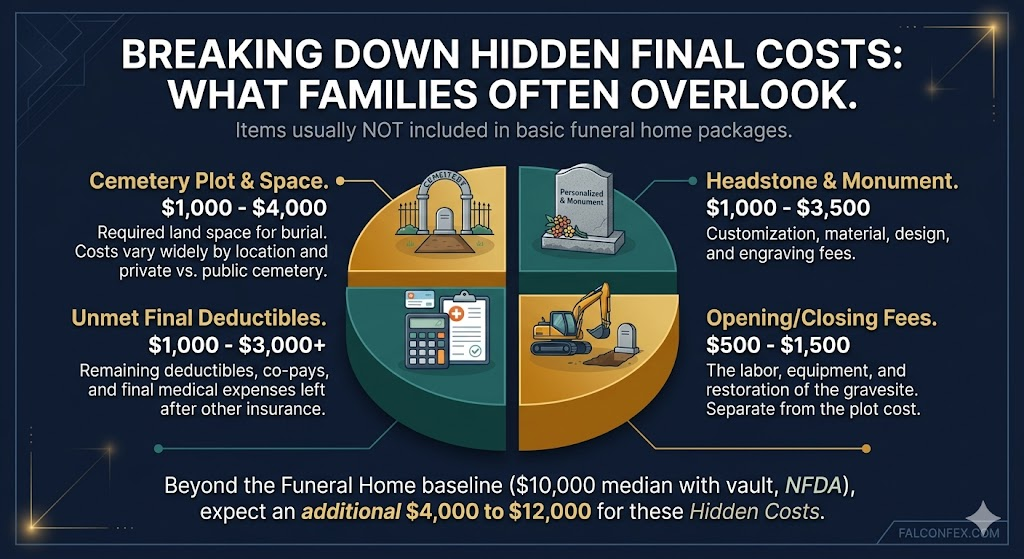
It is vital to note that these figures represent only the baseline funeral home costs. They typically do not include separate, necessary cemetery expenses, which can easily double the total bill:
- The Physical Cemetery Plot: $1,000 to $4,000 depending on location.
- Grave Opening and Closing Fees: $500 to $1,500.
- A Customized Headstone or Monument: $1,000 to $3,500.
- Obituaries, Flowers, and Clergy Honorariums: $500 to $1,000.
Furthermore, comprehensive financial tracking by consumer advocates at MoneyGeek (2026) highlights that a family's final expenses are rarely limited strictly to the funeral home. Out-of-pocket medical expenses, unmet health insurance deductibles, hospice copays, and leftover personal debts in the final year of life frequently add several thousand dollars to a family's immediate financial obligations.
When a person passes away, these bills come due almost immediately. While a person may have value tied up in a home or traditional investments, estate assets can take months — sometimes over a year — to clear probate court. A dedicated final expense life insurance policy, however, is designed to pay out in cash within days of a claim, giving families immediate liquidity when they need it most.
3. Why Traditional Life Insurance Often Falls Short for Seniors
A common misconception among individuals entering their retirement years is that their old workplace life insurance policy or a standard term life policy will protect them forever.
While term life insurance is a fantastic tool for young families looking to replace a career income or pay off a 30-year mortgage, it possesses a structural expiration date. Most term policies naturally lapse when the policyholder reaches age 65, 70, or 75. Attempting to renew a term policy or purchase a new, massive whole life policy at that age can yield prohibitively expensive premiums due to advanced age or evolving health conditions.
This structural gap is precisely where final expense insurance shines.
Unlike massive policies designed to replace twenty years of a working salary, final expense insurance (often referred to as "burial insurance") features smaller, highly targeted face values — typically ranging from $5,000 to $35,000. Because the payouts are intentionally tailored to match actual end-of-life bills, the monthly premiums remain highly accessible and affordable, even for seniors operating on a fixed Social Security or pension income.
4. Agent's Product Guide: The Two Final Expense Pathways You'll Quote
As the final expense market expands, the agents who close the most business are the ones who can clearly explain the structural differences between policy types on a live call. At FalconFEX.com we don't sell policies to consumers — we deliver exclusive, real-time live transfer leads to licensed final expense agents and agencies, connecting you with seniors who are already on the phone and ready to talk coverage. The two product pathways below are what you'll be quoting on nearly every transfer. (New to our program? Our Agent FAQs page covers the most common questions agents ask before partnering with Falcon FEX.)
Simplified Issue Plans
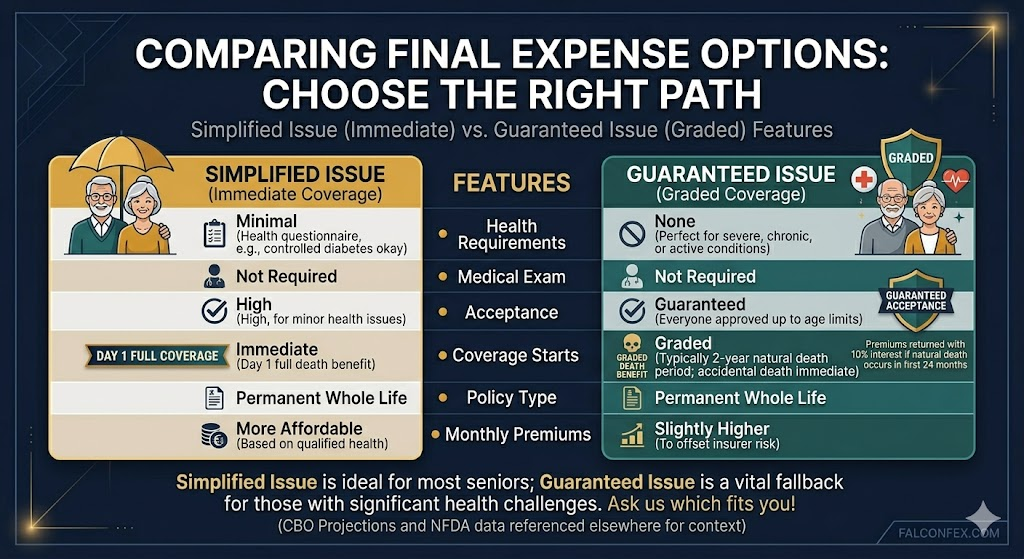
These plans are designed for individuals with minor, well-managed health conditions (such as controlled high blood pressure or type 2 diabetes). They require no physical medical exams. Instead, coverage is approved based on a simple, honest medical questionnaire and a digital prescription history check. Because the insurance company takes on a clearer, quantified picture of your health, these plans offer the lowest monthly premiums and grant immediate, first-day full coverage from the moment your first premium is paid.
Guaranteed Issue Plans
These plans act as a crucial financial safety net for seniors with more severe, chronic, or recent medical conditions (such as active cancer treatments, recent heart attacks, or advanced organ disease). These policies feature zero health questions — you cannot be turned down based on your medical history. To account for the heightened risk, these policies come with slightly higher premiums and a standard two-year graded death benefit period.
How the Graded Period Works: If the policyholder passes away from natural causes during the initial 24 months of the policy, the beneficiaries receive all paid premiums back with an additional interest bump (typically 10%), rather than the full face value. If death occurs via an accident at any time, or if natural death occurs after the 24th month, the full face value is permanently and immediately active.
5. Why This Market Matters for Agents
Ultimately, the surging growth of final expense insurance isn't just a story about demographic statistics, CBO charts, or funeral home cost inflation. It's a story about millions of seniors actively raising their hand for help — and a generational opportunity for the agents and agencies positioned to answer that call.
Every locked-in final expense policy an agent places means one more family that won't have to scramble for credit cards, launch online fundraisers, or take out high-interest loans during the hardest week of their lives. That's the real product behind every premium dollar — and it's why prospects stay on the phone, why persistency holds, and why this vertical continues to outperform.
Falcon FEX exists to put those conversations in front of agents who can have them well — through exclusive, real-time live transfers from pre-qualified seniors who are ready to talk coverage right now.
Want to Write More Final Expense Business?
Falcon FEX delivers exclusive, real-time live transfer final expense leads — pre-qualified seniors on the phone, ready to talk coverage. Stop dialing aged data and start closing.
Request Live Transfer PricingCited Sources & References
- Choice Mutual. (2026). How Much Does A Funeral Cost? (2026 Breakdown By State). Retrieved from Choicemutual.com.
- Congressional Budget Office. (2026). The Demographic Outlook: 2026 to 2056. Retrieved from Cbo.gov.
- Funeral Home Directories. (2026). How Much Does a Funeral Cost in 2026? Complete Price Guide. Retrieved from Funeralhomedirectories.com.
- MoneyGeek. (2026). The $8,300+ Death: What Americans Pay When Someone Dies. Retrieved from Moneygeek.com.
- National Funeral Directors Association. (2025). NFDA Cremation & Burial Report / Consumer Awareness and Preferences Study. Retrieved from Nfda.org.
- U.S. Census Bureau. (2024). U.S. Population Aging as Nation Turns 250. Retrieved from Census.gov.
